
July 29, 2023
~3.5 miles hiked
I sleep all the way through the night and my eyes pop open when people start moving. I already feel so much more rested than yesterday and I am relieved. I enter then kitchen where once again Gahl and Carrot are bustling about. Carrot asks me again, and just as enthusiastically, if she can make me toad in the hole, and then Allison and Chelsea, and we all agree. “I used to love toad in the hole,” Carrot says, “but now I can’t eat eggs. But I miss making it.”
All five of us sit around the table and have breakfast together, talking about this and that and talking in silly dog voices to Fern, who is trying very hard to persuade us to share our breakfast with her. We have a long time still until we leave for our flight so there’s really no sense of rush. It’s so pleasant being here in the midst of hikers, and among women. Chelsea, Gahl, and I talk about this later as we pack up, how we just rolled up and were immediately comfortable with each other when we arrived.
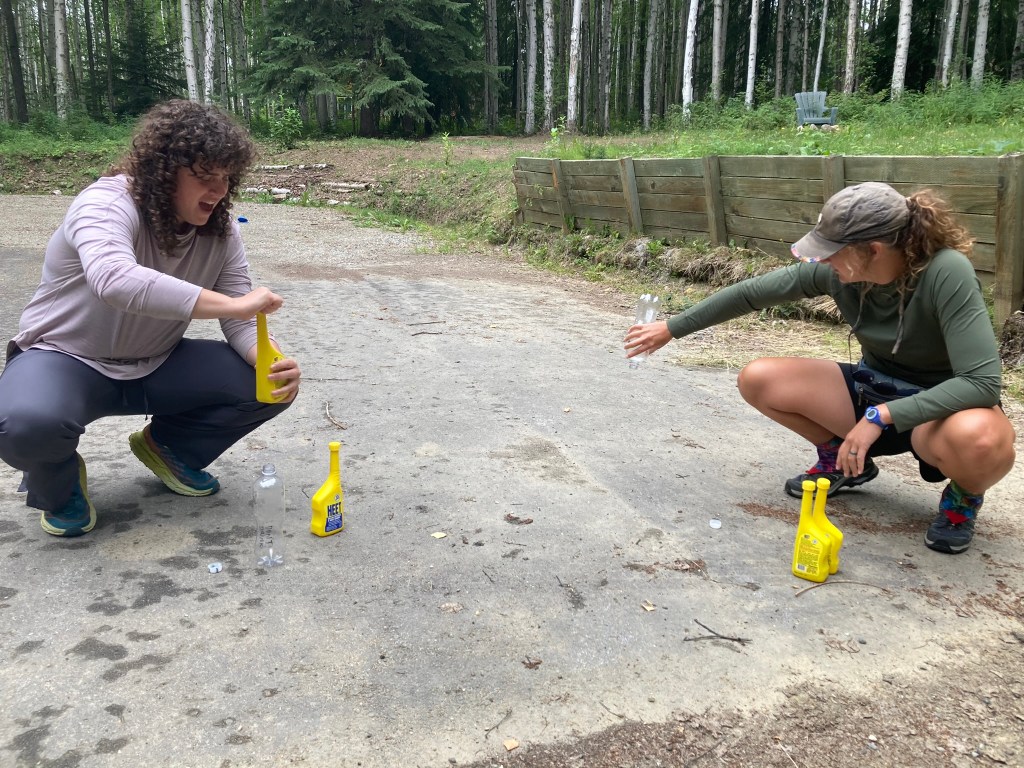
We finish up our packing. I paint my nails and do some phone things while I still have service and access to electricity. We pour our HEET into our bottles that we have marked with sharpies and duct tape so that we don’t confuse them with water. (That would be bad.) And then, after loading up, doing final checks, and taking a group photo, Allison takes us to the airport. Well, “airfield” is probably the more correct word for it. We’re taking a little tiny prop plane with the service Wright Air to the little tiny village of Anaktuvuk Pass, where our hike will begin. We check in, then set about waiting for the flight.

It’s a waiting room that feels like something you’d see at a small town bus station. There’s a coffee maker in the back, a wooden clock above the door. We get chatting with a guy sitting near us, a seasonal worker named Isaac who was just up at the ranger station in Anaktuvuk.
Soon one of the employees calls out “Anaktuvuk Pass!” and reads our names off her list. There are only seven passengers. We are led outside towards the plane. We’re all giddy as we take photos and board. It’s so small that you can’t stand up inside, so we hunch over as we crawl in and take our seats. The pilot hops in. “Hey, I’m Drew!” He proceeds to quickly rattle through some safety info and then we’re on the runway. Zoom! The takeoff is quick and zippy and the boreal forest is disappearing beneath us.

The flight is smoother than I expected. Beyond the windows stretch vast creeks and rivers with wiggly bends and sandbars. We fly over one very massive river. I ask Carrot what river it is, and she replies that it’s the Yukon, the third largest river in the country. There are roads, and little communities here and there, but in general the land looks vast and sprawling and impossible to take in. This all disappears for a while into clouds, then pops up again, and hides once more.
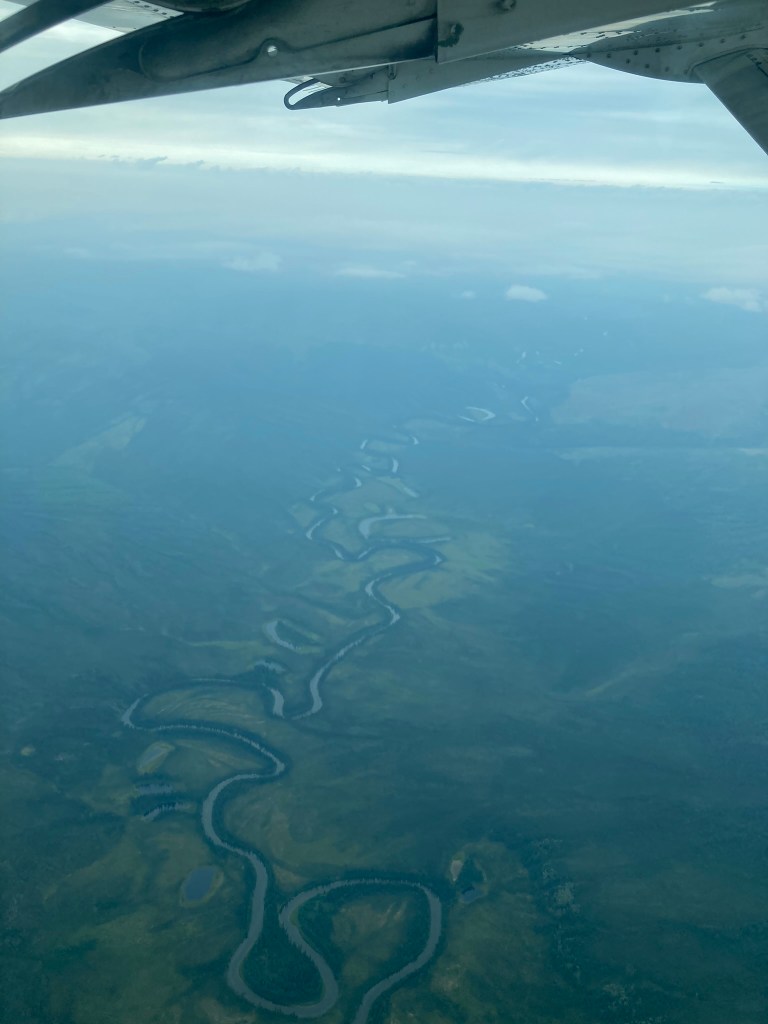

Soon we’re passing over some hills, and then, BOOM! We’re in the mountains. They rise dramatically from the green Alaskan carpet and into the sky. We’re not flying over mountains; we’re flying among them. Their craggy peaks are so high I have to strain to see the top from the teeny airplane window. Then there’s a lake whose water is so impossibly greenish blue. Over and over the mountains rise, and over and over they are wondrous.

The pilot makes a turn, threading through a break in the peaks, and then a wide river valley with a tiny village comes into view. Anaktuvuk Pass! A sharper turn, and then we are losing altitude, and then we are touching down on a gravel runway.

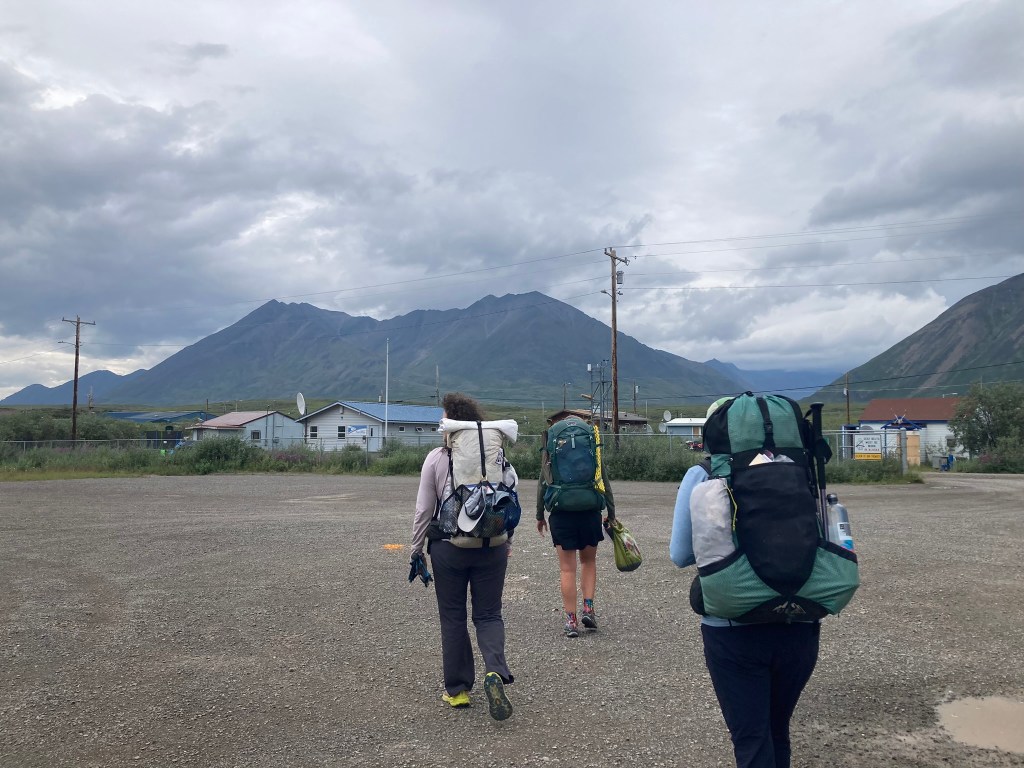
People come to greet the plane when it lands. In addition to ferrying people to and from the village, the plane also brings supplies for the store—today many cases of Dr. Pepper—and mail. We bid farewell to Isaac, the seasonal worker from Ohio who had been stationed at Anaktuvuk and is going to Bettles today. We get our packs on and then make for town.
Before we get there, we’re stopped by a couple of folks on an ATV. They ask where we’re going and we tell them. The one, a younger looking guy, tells us that it’s beautiful there, and that he goes out there all the time. The woman agrees.
“If you see footprints, take photos,” she adds.
“Like, animal footprints?” one of us asks.
“No,” she begins, and then says “no” again when we ask if she means human footprints.
“Look for other footprints. Bipedal. You know, we have stories here like a lot of other places. Bigfoot, Sasquatch, the big hairy man. And there are littler people, too, like the leprechauns in Ireland.”
The guy holds up his lighter. “If you see footprints about this big, take pictures. They’re out there. One time I was out there and I found this tiny little bow and arrow. I tried to shoot it, and I couldn’t. It was so small.”
“Yes,” the woman continues, “Make sure you ask permission to camp somewhere. Sometimes people camp somewhere they shouldn’t, and you know, they get rocks thrown on them. It happens.”
They tell us to have a good trip and zoom away on the ATV and we head towards the village. It’s very small, but there’s a post office, metal street signs on gravel roads, and a store where some people are unloading the large quantity of Dr. Pepper that was just shipped in on the plane. The folks who live here are mostly Nunamiut, indigenous people who have lived in this area for centuries. As Carrot explains it, the indigenous people in Alaska were “marginally less fucked” by colonization than in the lower 48 in that they weren’t forced onto reservations and are largely still able to practice many traditional ways of life, including sustenance activities like hunting.

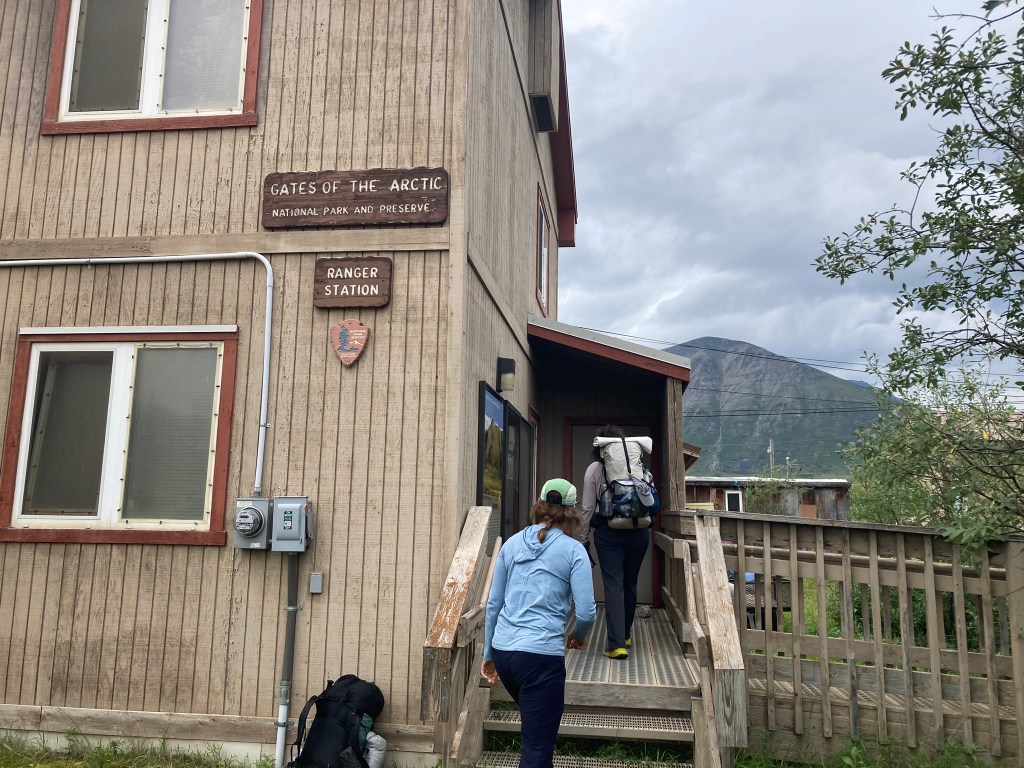
The ranger station is closed, which is unfortunate because apparently it’s really cool in there and they have all kinds of books and maps on the area. Shoot. It’s time to hike! We all take a quick pee break and then put our incredibly heavy packs on and head west, onto the tundra and into the mountains.
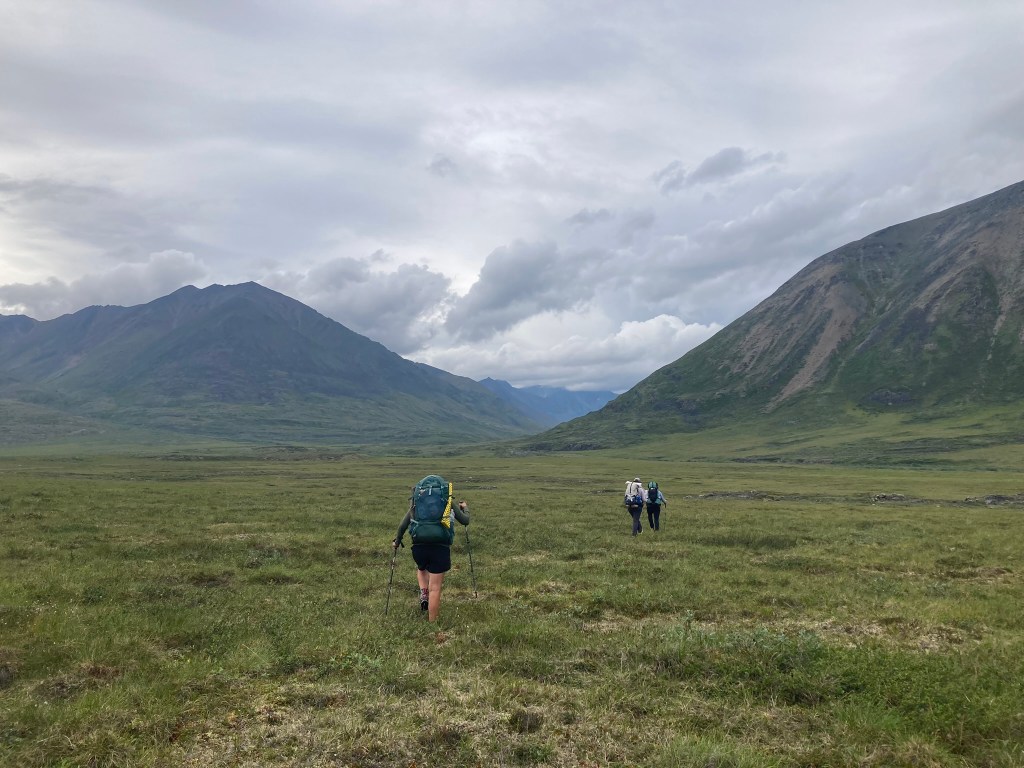
There’s an ATV track at first, but it disappears and we decide to cut right across the bog towards a creek that we have collectively set as the first stage of this trip. “We’re on the tundrurrr!” Carrot exclaims, using the “ermahgerd” voice that sets me cracking up. Sure enough. It’s boggish and springy. Every step is lichen, grass, soft earth, and what looks like a million little miniature plants. The ground springs right back up when we take a step. Sometimes it’s wet, like bog mud, and other times it’s like a psychedelic breathing sponge you’d see in Alice and Wonderland.

The hill starts to rise and we notice blueberries everywhere, though they’re growing not on bushes but on the tiniest little sticks so close to the ground. Realizing we have nothing but time, we stop and sit—lounge, in my case—among the berries and graze upon them.
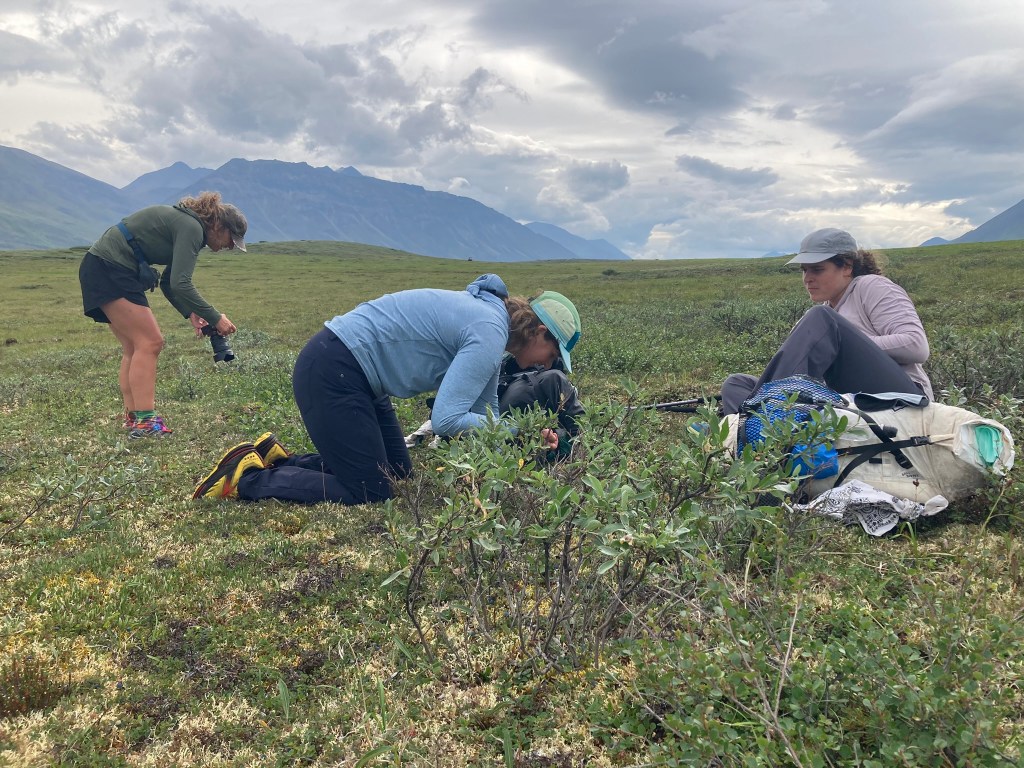
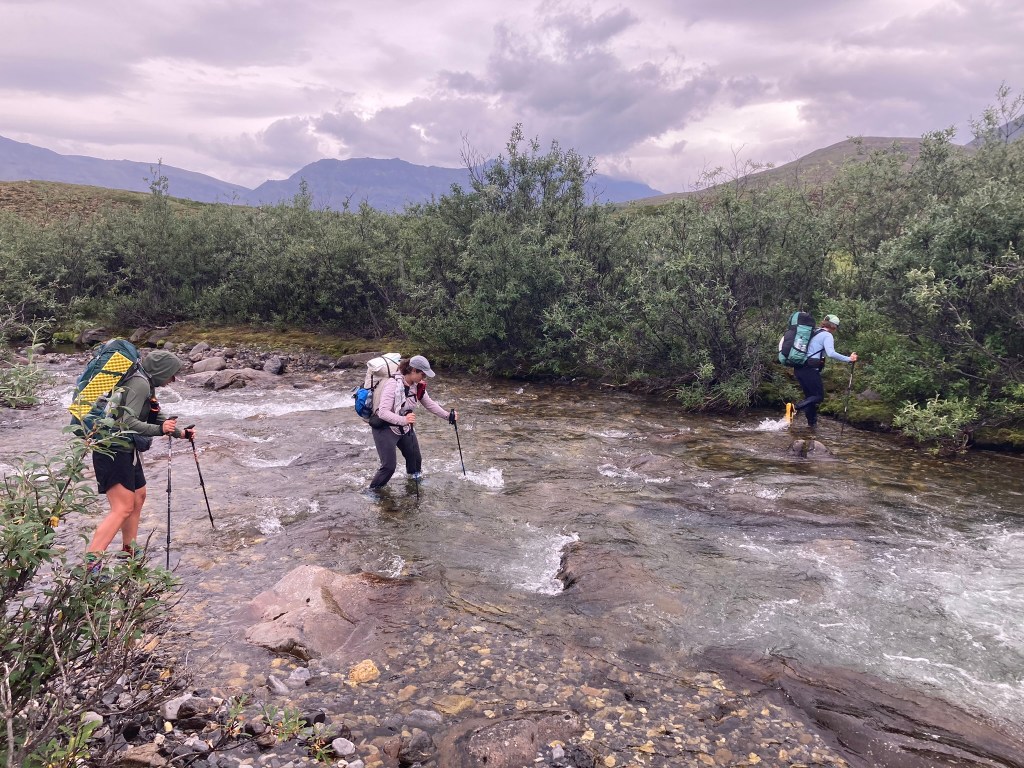
Uphill after that, and then across the bog. We go a little higher and find some good walking that’s a little more sturdy, then we drop down towards Contact Creek and cross it. It’s a little more intense of a crossing than I was expecting, the frigid water running thigh-high. I lock in and concentrate, turning upstream and ensuring I have three points of contact (creek).
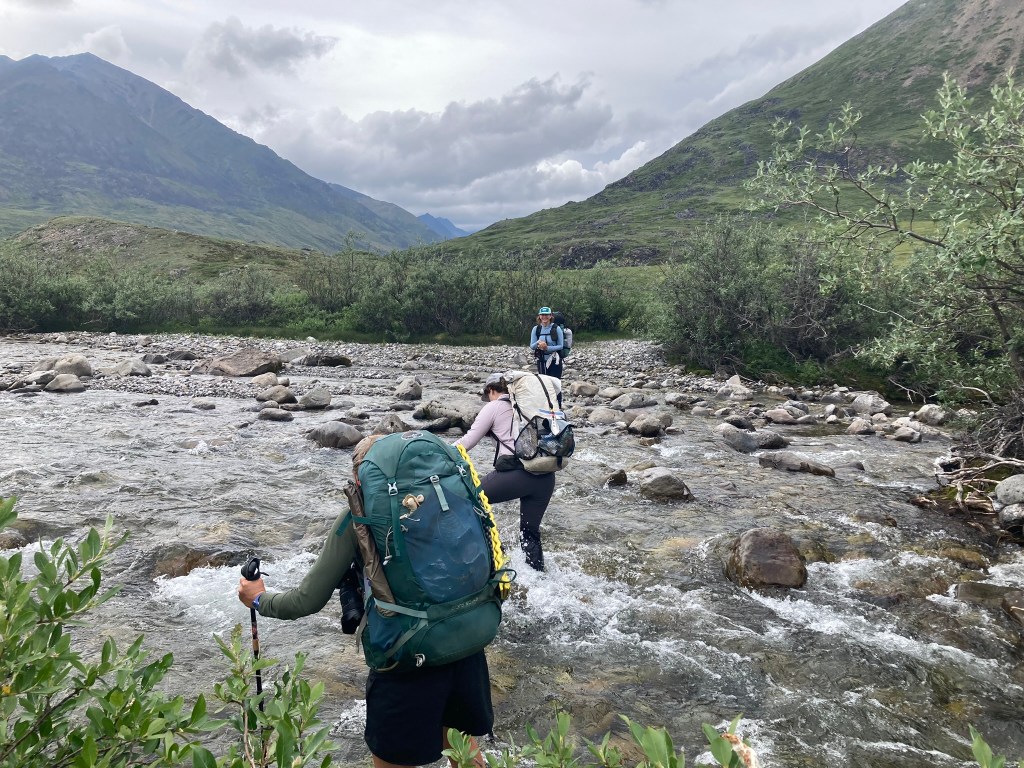
“That was the biggest river crossing I’ve ever done,” Chelsea says when we’ve all made it across. “The water wasn’t that high in the Sierra in ’21.”
It was definitely colder and more intense than much of last year’s PCT water, though the memory of river crossings in 2017 on the JMT is still seared into my eyeballs. Still, this one was pretty big.
We gather water on the other side of the creek, then climb up a hill and away from the suddenly horrible mosquitoes to filter it. I connect my Sawyer Squeeze—which I backflushed and stored properly at the end of the hiking season last year—to the end of my CNOC bladder, squeeze it over my bottle, and… nothing. Oh, come on. I squeeze harder, to no avail.
“Shit!” I exclaim. “I knew I should have tested it before I left.”
It looks like Chelsea is having the same issue. “This one isn’t even that old,” she says.
Gahl’s Sawyer is working just fine, as is Carrot’s SteriPen. The latter offers her filtration method to me, and I take her up on it.
“I always wondered why no one else used a SteriPen on my trips, and then my friend Matthew said to me once, ‘You’re just drinking water with everything still in it. You’re rawdogging it.’ Like, yeah I like to drink my shrimps.”
There are no shrimps in this water, I don’t think. Luckily it looks pretty clear. But I fill it all the way anyway and stick the SteriPen down into the bottle, press the button, and see the UV light come on. It takes 90 seconds to work, and then a little happy face pops up on the screen.
I’m so upset with myself. I know better. I know Sawyers are capricious and that I should have checked this before going out into one of the most remote parts of the country.
“I brought the weight of the filter and I can’t even use it!” I grumble, pulling up my bag and shoving the filter back in its place.
“What else do you have in that bag?” Carrot jokes. “Sarahmarie opens her pack and it’s just games. Uno.” She pauses, grinning, then adds, “hacky sacks.”
I laugh my way through the story about how in India I packed a birthday decoration to a summit of a mountain, and then how last year Jumbo decorated my tent and we all carried decorations all day. Also, the first day I was here I showed everyone the crocheted frisbee, mini Uno, and nail polish I brought, so I guess this idea about a pack full of games tracks.
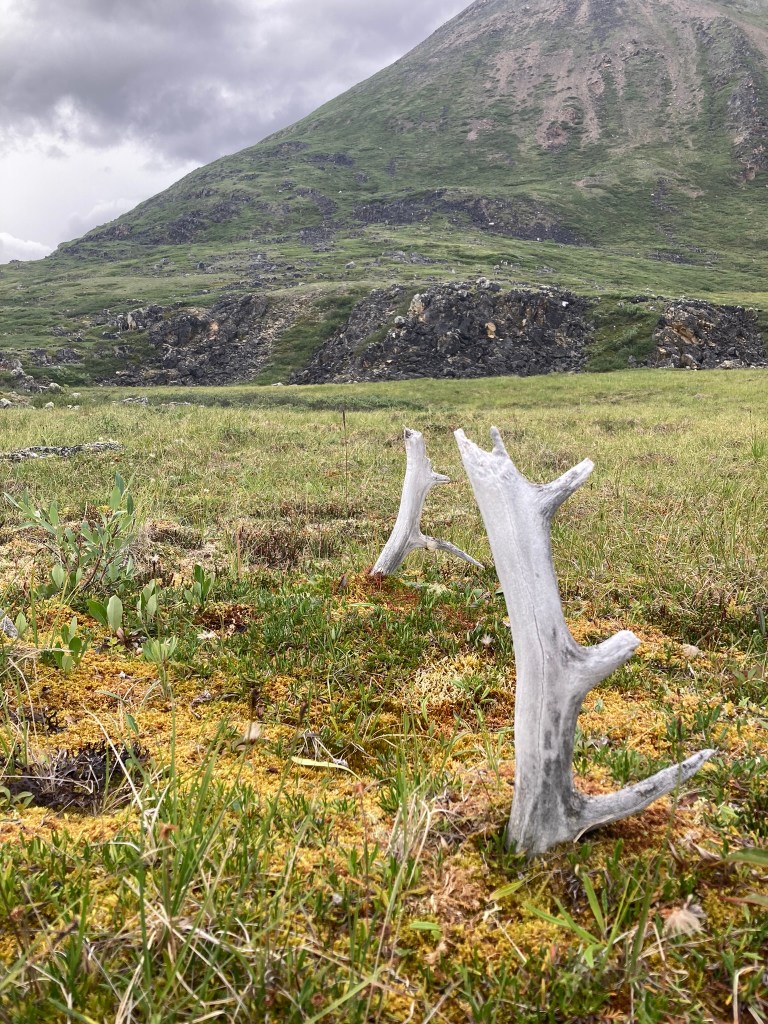
We descend again into a lumpy field dotted with antlers. They’re everywhere. “This was the killing place, I guess,” Gahl notes.
“Ye olde killing place,” adds Carrot.
We carry on through the killing place and then up onto a kind of shelf, trying to avoid the bogs.
It’s fine at first, sort of rocky and then licheny, and then it gets more brushy and hard to see where we’re going. We start to descend back into the boglands, which at one point entails a small rock scramble. Across the creek there’s what looks like an ATV track. We have to cross the creek again to get to it, but it looks worth it. When I come out of the creek, my feet are in agony. It’s a sharp, burning pain that immediately has me feeling so sad, so depressed, like the physical sensation of the frigid water triggered a direct emotional response. It goes away after about a minute, but it is so bizarre. Later I tell Carrot about this and they say they’ve heard it called the “screamin’ barfies,” that intense post-water crossing pain. Apparently I’m not alone.
It is really, really nice walking on the ATV track after that, and it was absolutely worth the screamin’ barfies to get there. For the first time all day we’re actually cruising and I can take in the world around me. We’re in a vast valley flanked by towering mountains. On the right, the tops of the peaks are rocky, craggy, and to the left, they’re a little more rolling green. It’s not unlike Scotland; in fact, the group asks me if it reminds me of Scotland at one point. This feels a little more wild than what I’ve experienced there, but from what I’ve heard about northern Scotland, this definitely has vibes. It’s beautiful. Stark, magnificent, a little bit intimidating, but beautiful.
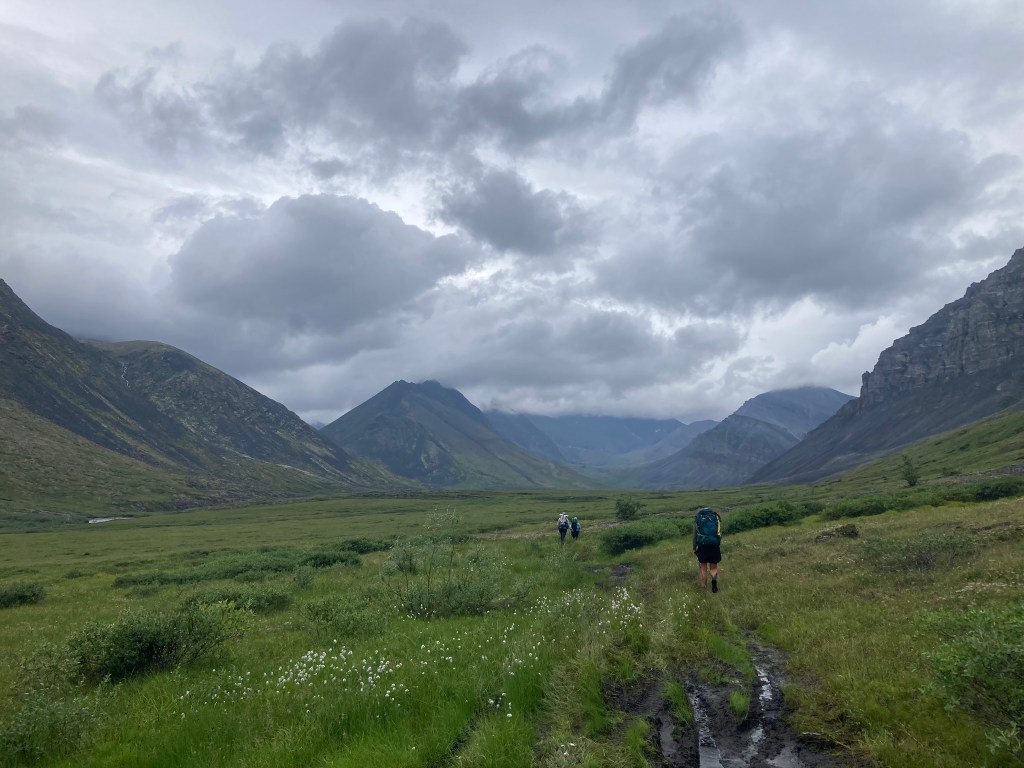
The track turns boggier, and then we come upon two ATVs. On one of them sits a kid who looks at us open-mouthed and asks, to Chelsea and me, “You’re wearing shorts? Are you not getting bit?!” We are, in fact; the mosquitoes have just gotten terrible. On the other ATV sits the guy we were talking to down in the village, the one who told us about the tiny bow and arrow. He asks how our hike is going and then says he’s taking this guy—he gestures to a white guy standing between the two ATVs—hunting sheep. (Dall sheep, we think. They’re sort of like bighorns.) Carrot asks how many sheep they can hunt, and the guy replies that if you’re a resident you can hunt four per year, and if you’re not a resident you get one.
We wish them a pleasant journey, and they wish the same to us, and we continue on our way.
The track continues but it’s super muddy now. At one point Chelsea takes a step and sinks to mid-calf into mud. The bog has taken its first victim!

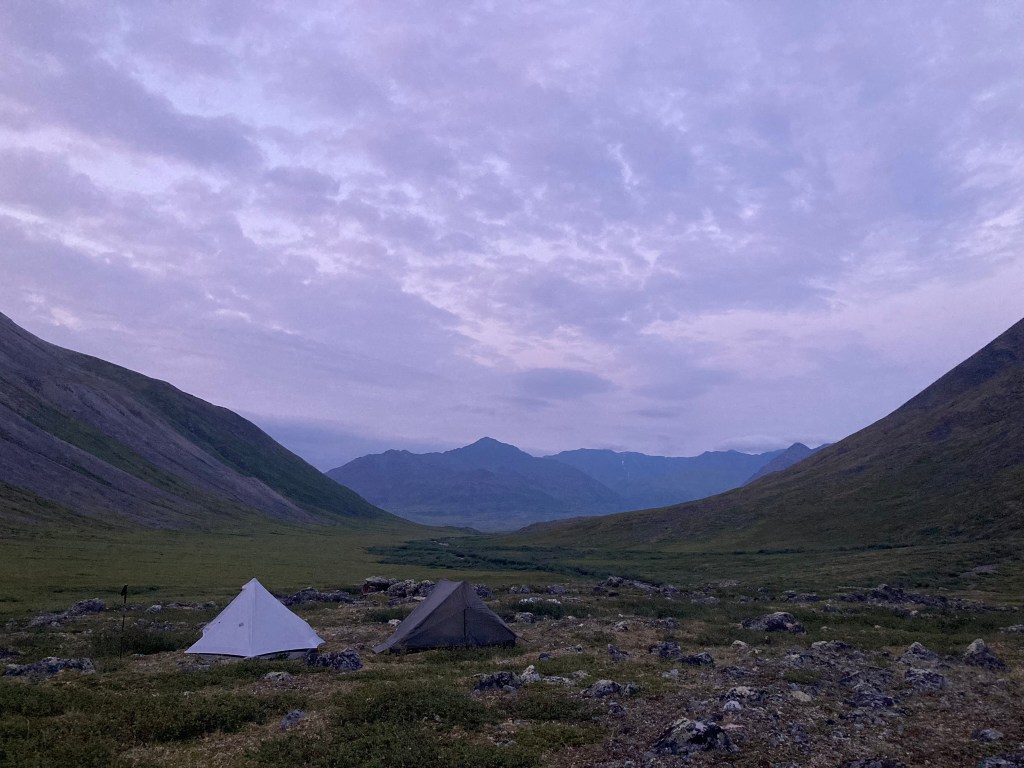
We walk a little farther. Carrot points out a rocky area across the valley towards the stream and suggests it as a campsite. We agree, and then trudge across what becomes very wet land. Alright, I’m accepting that my feet are going to be wet this entire week. The campsite we find is lovely. Chelsea sets off for an evening cathole and Carrot checks out all of the sites while Gahl and I claim our “bedrooms” and start setting up our tents. The ground is so soft that I consider not even blowing up my sleeping pad in the first place. I do, though, and all of my chores take me forever so that when I finally join the others for dinner they’re done cooking before I even start. I struggle to light my stove, but Chelsea comes to the rescue with her long-nosed lighter. (Is that what one would call it?) And before long I’ve got warm couscous in a plastic bag. Yum.
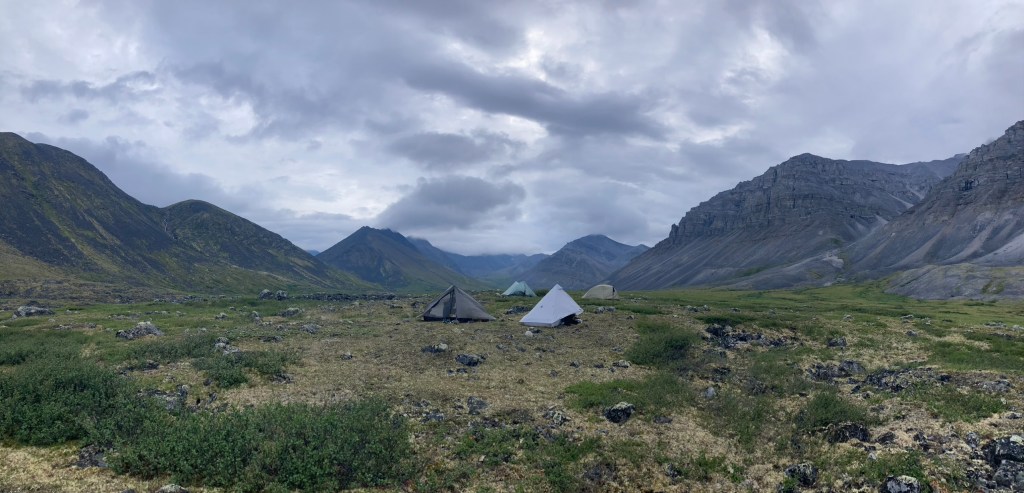
One by one the others finish dinner and go off to their tents for cozy sleeping bag time and I’m left there finishing my tea and staring at the waterfall tumbling down from the mountain on the south side of the valley into Contact Creek. It’s peaceful. The ground is so soft. There’s a little breeze.
I finish my chores and retreat to my tent. It’s 9 and still so light. Hiker midnight in Alaska. I wake up to pee at 2 in the morning and it may as well be afternoon. I guess a headlamp was another thing I packed but really didn’t need to.

 Sarahmarie Specht-Bird
Wow. The bog’s first victim. I’m riveted. Thanks for writing.
LikeLike